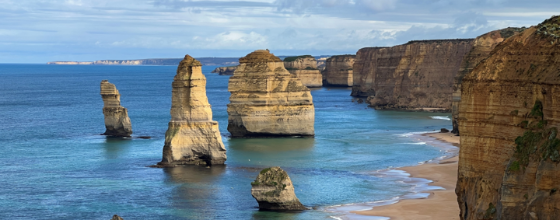
How microscopic amoebas with shells helped date the Twelve Apostles
Researchers from the University of Melbourne have used 50 years of samples collected from the Twelve Apostles to figure out how the breathtaking landmarks were formed, and how old they are.
The Twelve Apostles, which are a series of limestone stacks rising up out of the Southern Ocean on the Victorian coastline, attract over 2.8m visitors every year and are a major attraction for tourists travelling along the Great Ocean Road.
The paper, which was published in the Australian Journal of Earth Sciences, analysed microscopic amoeba-like fossils – or microfossils – found in the limestone rocks to help date the sea stacks.
According to the lead author, Associate Professor Stephen Gallagher from the University of Melbourne, the fossils are from microscopic plankton-like organisms that lived in the ocean.
“Those planktonic microscopic fossils, which are protozoans, tell us the age because those things have evolved at a particular time and they became extinct at a particular time,” he said.
Thanks to the very specific evolution and extinction dates of these microfossils, the team was able to determine the age of each layer of limestone in the sea stacks.
Their findings indicated that the oldest limestone was deposited almost 14 million years ago, with the youngest limestone dating to around 10.5 million years ago.
But the age of the Twelve Apostles is not the only thing that these tiny fossils can tell us, according to Assoc Prof Gallagher.
The layers represented by the Apostles are some of the best preserved and most accessible records of climate and sea level during a period of Earth’s history where quite a lot of climate change variation was happening, he said.
“Those little microscopic things, they live on the seabed or they float around in the ocean. And the ones that float in the ocean are really good because they record the chemistry of the ocean at the time, and they're related to nutrients and all sorts of ocean conditions, temperature, and so on so forth,” Assoc Prof Gallagher told the AusSMC.
Co-author of the paper, Dr Clifford Mallet, conducted his PhD on the Twelve Apostles in the 1970s, and his work formed the basis of the recent paper’s findings.
“The first task was to photograph the whole section from an aeroplane flying at cliff height using an aerial camera we borrowed from the Department of Forestry,” he told the AusSMC.
Critically, he was also able to collect fossil samples from sections of the cliff at one metre intervals in areas that are now inaccessible.
“I was, in terms of current-day occupational health and safety, a complete disaster. I was by myself; a young man with a backpack on and a rope, so that when I got too close to the edge, I tied myself to the nearest tree to make sure I didn't fall off.”
Because of Dr Mallet’s efforts in the 1970s, those samples from inaccessible areas were held in the Museum of Victoria, enabling the researchers to analyse microfossils from a full cross-section of the cliff face.
The researchers were able to determine that around 8.6 million years ago, uplift of the tectonic plates pushed the cliffs out of the ocean, halting the limestone deposit but allowing it to become the spectacular limestone stacks that we see today.
You can find more details on the paper and the AusSMC Briefing on Scimex here.
This article originally appeared in Science Deadline, a weekly newsletter from the AusSMC. You are free to republish this story, in full, with appropriate credit.
Contact: Steven Mew
Phone: +61 8 7120 8666
Email: info@smc.org.au