

By Steven Mew, the Australian Science Media Centre
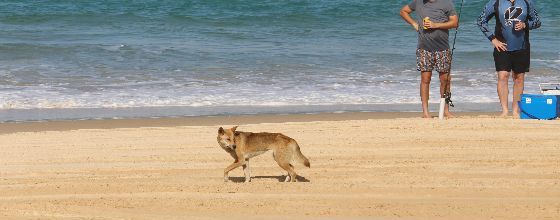
The Queensland Government has culled dingoes involved in the tragic death of Canadian backpacker Piper James.
Ms James’s body was found on the island on January 19, reportedly surrounded by a pack of dingoes. But the coroner’s report found that, although the 19-year-old was bitten before she died, drowning was the most likely cause of death. Despite this, the state government went ahead with the cull.
Experts contacted by the AusSMC said they do not believe that culling the dingoes is the right approach.
Dr Mathew Crowther from the University of Sydney told the Centre the decision was "unwise" and taken without consulting the traditional owners of K’gari, the Butchulla people, or experts in dingo biology.
“The dingo population on K’gari is small (at most ~200 individuals) and has low genetic diversity, meaning that culling poses a genuine threat to the long-term viability of the population,” he told the AusSMC.
“Culling will do little to prevent aggressive behaviour, as it does not address the underlying causes of dingo–human conflict.”
According to Assoc Prof Bill Bateman from Curtin University, it is unlikely that culling the dingo pack will have any effect other than driving down dingo numbers.
“What needs to be done is the introduction of clearer, safer rules for visitors and perhaps a cap on their numbers,” he said.
Reports of difficult interactions with dingoes on K’gari go back as far as 2001, when a boy named Clinton Gage was killed after wandering away from his family.
Dingoes were culled in response to that incident as well.
Aussie experts say the situation on K’gari is complex and there are no simple solutions.
Prof Rowland Cobbold, from Southern Cross University, said that any response should be based on evidence and expert opinion across multiple fields, including wildlife ecology, animal welfare and ethics, human health protection, and tourism, among others.
“Experts in each of these fields need to be consulted, along with key stakeholders such as local wildlife rangers, traditional owners and land care groups, and users and managers of K’gari’s assets,” he said.
People should be treating potentially dangerous animals, such as dingoes, in the same way as crocodiles are in northern Australia, or bears in other parts of the world, according to Dr Mike Letnic from the University of New South Wales.
“By that, it probably means we avoid potentially harmful interactions by discouraging feeding, and modifying our behaviour so we don't end up being alone, especially at night or in the early hours, which could make people vulnerable to groups of dingoes,” he told the AusSMC.
Dr Kylie Cairns from the University of New South Wales agreed that, rather than culling dingoes, we should change how we interact with them, as a more effective harm-reduction strategy.
“We cannot stop dingoes from behaving like wild predators, but us humans can behave in ways to limit the risk to ourselves and others," she said.
You can read the full AusSMC Expert Reaction here.
This article originally appeared in Science Deadline, a weekly newsletter from the AusSMC. You are free to republish this story, in full, with appropriate credit.
Contact: Steven Mew
Phone: +61 7120 8666
Email: info@smc.org.au